
An Interview with Jalal Tehrani
By Reza Ashofteh
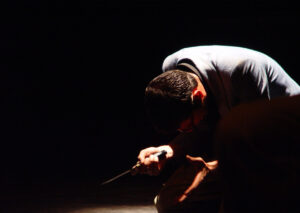
The Tank tells the story of two brothers who seek revenge against their half-brother, their stepsister, and their father’s second wife. Set in a petrol station, the play unfolds through a father’s relationship with his sons.
After a seven-year absence from the stage, Jalal Tehrani returned with this production, once again affirming his influential place in Iranian theatre—despite describing his own work as “amateur theatre.”
We spoke with him about The Tank, his return to directing, and his artistic approach.
When did you write The Tank? It was staged once before, wasn’t it? Why did that production end so quickly?
I wrote the play in 1998, and it was first staged at Molavi Hall in 2002. Immediately afterward, Nefertiti opened at the City Theatre of Tehran. Managing two productions simultaneously placed enormous pressure on us, and the quality of both inevitably suffered.
As a result, we decided to end the run of The Tank in order to fulfill our contractual obligations to the Centre for Performing Arts regarding Nefertiti. After that, we repeatedly hoped to revive The Tank, but circumstances never allowed it—until now.
Your last production was almost seven years ago. Was your absence from the stage a deliberate decision?
Partly. Some of it was a conscious choice, and some of it was the result of circumstances beyond our control.
At one point, we deliberately stepped away from directing because we felt we needed time to reorganize ourselves artistically. Later, conditions simply weren’t favorable. Two or three projects reached the planning stage but were cancelled before rehearsals could begin.
You had also planned to stage a production in 2005, didn’t you?
Yes, but it never happened.
Many people consider Hey, Big Man, Don’t Cry! one of the landmark productions of Iranian theatre in the 2000s. Its mise-en-scène, lighting, stage design, and performance style introduced innovations we had never seen before. Did the success of that production make it more difficult to return to directing? Did it create expectations that were impossible to meet?
Do you mean that we might have been afraid we couldn’t live up to it?
Exactly. Didn’t that production make your subsequent work more difficult?
Every project becomes difficult.
At the beginning, a production always seems manageable. As rehearsals progress, it grows larger, heavier, and more demanding.
People remember Hey, Big Man, Don’t Cry! very fondly—both theatre professionals like yourself and audiences with no theatrical background.
Ironically, although the production ran for only twelve performances, the only one that satisfied me even slightly was the eleventh.
Experimentation always involves two possibilities: success and failure. I’ve never been afraid of failure. The same is true of The Tank. Even today, it remains a high-risk project.
Have you ever wanted to further develop the theatrical techniques you explored in Hey, Big Man, Don’t Cry!?
Of course.
One of the functions of experimental theatre is to introduce new techniques and performance methods into mainstream theatre. Hey, Big Man, Don’t Cry! offered many ideas that could continue to influence professional theatre in Iran.
I agree with you completely. But I’d like to clarify something.
Over the years, I’ve realized that I don’t really identify with the term experimental theatre. I sometimes use it out of habit, but I think the word amateur describes my work more accurately.
That’s the kind of theatre I enjoy making.
By “amateur,” do you mean theatre that moves toward the unknown—toward discovery?
Exactly.
So you aren’t interested in professional theatre in the conventional sense? Traditionally, professional theatre brings together artists who apply skills they’ve already mastered to a new production.
It’s all relative.
In reality, there is no such thing as completely professional theatre. Even the most experienced directors and actors encounter new texts that require experimentation.
How did rehearsals for this revival differ from the original production? One obvious difference is the inclusion of female performers, who weren’t present in the first version.
Yes.
We deliberately tried not to repeat the original production.
Once you begin asking different questions of the text, the production gradually changes. A new question creates a new perspective.
As our perspective evolved, previously unnoticed aspects of the play emerged while others receded.
The women didn’t appear because we planned them from the beginning—they gradually revealed themselves during rehearsals.
The three original actors have returned after ten years. Has that changed the performances?
Absolutely. They’re older and far more experienced.
Their understanding of the text has deepened, and they’ve become more generous toward it.
At the same time, they’ve also become more cautious. They carry the memory of what they achieved in the past, and now they’ve entered unfamiliar territory without knowing whether they’ll succeed again.
One of the central themes of The Tank is murder. Surely age changes an actor’s understanding of violence. Someone in their twenties experiences it differently than someone in middle age.
I agree.
You can see that difference in the performance. In the original production, the actors’ energy created an emotionally driven performance. Today we’re searching for deeper motivations behind every action onstage. Perhaps that’s simply what happens as we grow older.
The play itself was written nearly fourteen years ago.
Yes. The original script dates from that period.
Compared with your later works, The Tank seems much more rooted in social and family relationships. In plays such as Hey, Big Man, Don’t Cry!, your work becomes increasingly philosophical and universal, moving beyond specific social contexts. Why did your focus change?
I don’t really see it as a matter of “before” and “after.” The Boatman was written even earlier and is far more abstract. There are probably two reasons. First, perhaps I simply wanted to experiment with writing a social drama, and The Tank was the result. Second, I originally wrote it for radio, and radio productions inevitably respond to the social context in which they’re produced.
How did your collaboration with Alireza Mashayekhi begin? As far as I know, he hadn’t previously worked in theatre.
He hadn’t. I don’t remember exactly how we first met.
When I became familiar with his Meta-X theory, I discovered striking parallels between his ideas and the theatrical experiments we were pursuing. That inspired me to explore his ideas on stage.
Could you briefly explain what Meta-X is?
Meta-X is a theory of multicultural music. Its central idea is that different musical cultures should coexist without being forced into harmony. That’s very different from fusion music, which tries to blend traditions into a unified style. Meta-X allows each musical language to remain fully itself. I find that a profoundly social idea. Professor Mashayekhi developed this theory during the 1970s.
The stage design also seems very different from the original production.
Yes. The first production was built using the technical resources available at Molavi Hall at the time. This version is much more minimalist.
Lighting plays a major role in this production.
Very much so. Lighting transforms minimal elements into something monumental. Farshid Mossadegh’s lighting design is exceptionally inventive. As always, his work elevates the entire production. I’ve always believed that minimalism can possess a certain nobility. When a stage becomes overcrowded, it loses that quality. I try to work with only what I truly understand.
The father seems to be the emotional center of the play.
Yes. The central tragedy is the chain of mistakes made by the father. Everything else grows out of those mistakes.
I saw the opening performance, but I still wasn’t sure what role the women play in this version.
Did you see the original production?
Yes.
It wasn’t a very successful performance.
So why introduce these women now, when they weren’t present before?
There are five female figures onstage. Two are actual characters. One is the stepmother, who is eventually shot. The other is a woman wearing a golden crown who continually ascends and descends the staircase. The remaining three function almost like stage operators. Those roles could just as easily have been played by men.
The crowned woman never seems fully grounded in reality.
Exactly. Using the stools, we literally lift her above the stage so that her feet never touch the ground. She remains suspended throughout the performance. I wanted her to become increasingly unreal—to stand in sharp contrast to everything happening around her. That’s why she wears a golden crown, a distinctive costume, and a long braided wig made of rope.
It’s almost as though she softens the violence of the play.
Yes. She introduces a certain tenderness into the production. One reason is simply to soften the atmosphere. Perhaps that’s because I’ve grown older and no longer feel the need to display violence so directly onstage. I don’t want to overwhelm the audience emotionally.
Structurally, she also connects different scenes. As she moves through the performance, she helps transform the theatrical space. In this production, scene changes are physical transformations. The space itself expands, contracts, and reshapes around the actors. The stylized appearance and movement of these women reinforce the magical atmosphere while allowing us to reshape the stage before the audience’s eyes. Personally, I’ve become less interested in placing audiences under intense emotional or psychological pressure. The text and the actors are already capable of doing that. If these three actors allowed themselves to rely solely on emotional performance, they could easily make the audience laugh or cry—as they did ten years ago. Today they’re stronger performers than they were then. But over the years, I’ve lost interest in turning theatre into a loud cry against the times. Audiences naturally enjoy laughing, crying, and becoming emotionally overwhelmed. What interests me now is something different. I want them to experience the atmosphere of The Tank.